
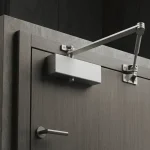
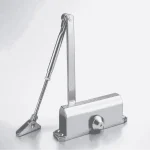
When outfitting a commercial building, the door closer matters as much as the door itself. The right unit regulates traffic flow, reinforces security, and reduces long-term wear on frames and hardware. Two options dominate commercial specifications: hold-open and non-hold-open door closers. Understanding the mechanical difference between them determines whether your facility runs smoothly — or fails inspection.
What Is a Hold-Open Door Closer?
A hold-open door closer engages a mechanical detent or electromagnetic mechanism once the door passes the 90–110 degree threshold, keeping it open without user effort. Releasing it is straightforward — push the door toward closed and the closer takes over automatically.
Benefits of Hold-Open Door Closers:
- Reduces mechanical wear in high-traffic environments by eliminating constant cycling
- Keeps lobbies, showrooms, and retail spaces feeling open and accessible
- Simplifies movement of large equipment, inventory, or furniture through doorways
- Lowers spring fatigue caused by repeated open-and-close cycles
At OUBAO, hold-open units use zero-leakage hydraulic technology with pistons machined to 0.01mm precision. When the door holds open, hydraulic oil pressurizes a secondary chamber. Lower-grade units fail at this stage — seals collapse and damping performance disappears within months. OUBAO hardware maintains stable performance down to -40°C, backed by a 5-year warranty and 2,000,000+ cycle rating.
If your facility prioritizes accessibility and traffic flow, a hold-open door closer is the right specification.
What Is a Non-Hold-Open Door Closer?
A non-hold-open closer automatically returns the door to the closed and latched position after every use — no exceptions. These units are the correct choice wherever security, fire compliance, or climate control is a priority.
Benefits of Non-Hold-Open Door Closers:
- Keeps fire-rated corridors, stairwells, and elevator lobbies compliant
- Maintains interior temperatures and reduces energy loss through open doorways
- Secures restricted areas including server rooms, storage, and executive offices
- Prevents doors from being left open in high-wind or high-pressure environments
Non-hold-open units meet self-closing and self-latching requirements under national building codes. For fire-rated openings, they are not optional — they are mandatory. OUBAO non-hold-open closers carry standard fire door approval and operate across the same -40°C to +50°C thermal range as the full product line.
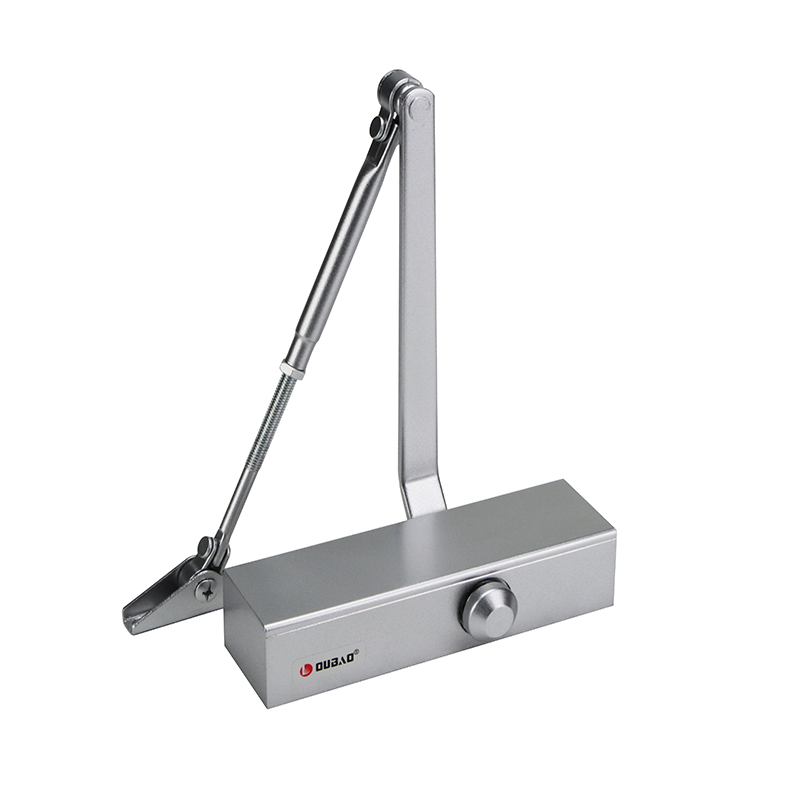
- Closing Force2、3
- Body Dimensions180 mm (L) * 51 mm (W) * 39 mm (H)
- Footprint60 mm * 38 mm
Hold-Open vs Non-Hold-Open: Feature Comparison
| Feature | Hold-Open Door Closer | Non-Hold-Open Door Closer |
| Keeps Door Open | Yes, holds at 90–110 degrees | No, closes after every use |
| Fire Door Approved | Electromagnetic only | Standard approval |
| Security Level | Lower — door remains open | Higher — door always latches |
| Energy Efficiency | Air may escape when held open | Maintains interior temperatures |
| Traffic Flow | Ideal for high-traffic areas | Best for controlled access |
| Piston Precision | 0.01mm (OUBAO Standard) | 0.01mm (OUBAO Standard) |
| Cycle Life | 2,000,000+ cycles | 2,000,000+ cycles |
| Common Applications | Lobbies, retail, warehouses | Offices, fire doors, exterior entrances |
Where Should Each Type Be Used?
Most commercial buildings use both types across different zones. Here is how to assign them correctly:
Entryways: Non-hold-open closers suit most commercial entrances for security and energy efficiency. Small retail shops with heavy foot traffic may prefer hold-open units to keep the entrance accessible during peak hours.
Fire-Rated Doors: Non-hold-open closers are mandatory. The only exception is an electromagnetic hold-open unit wired directly into the building’s fire alarm system — when the alarm triggers, power cuts and the door latches immediately.
Interior Doors: Use non-hold-open closers for restricted areas — offices, server rooms, storage containing sensitive materials. Use hold-open closers for conference rooms, corridors, and any zone that benefits from open traffic flow.
Choosing The Right Door Closer For Your Facility
There is no universal answer. The correct unit depends entirely on how the door functions within the building.
- Choose a hold-open closer when the door needs to stay open for extended periods and the opening is not fire-rated.
- Choose a non-hold-open closer when the priority is security, fire compliance, energy control, or consistent latching.
Door closers are straightforward to swap. If requirements change — a retail lobby gets reclassified, or a corridor becomes fire-rated — the hardware can be updated without replacing the door or frame. With a guaranteed 35-day lead time and factory-direct supply from a 106,000 ㎡ manufacturing base, OUBAO supports specification changes at any project stage.
Frequently Asked Questions
Can a hold-open door closer be installed on a fire-rated door?
Mechanical hold-open closers cannot be installed on fire-rated doors. Fire codes require these doors to be self-closing and self-latching at all times. Only electromagnetic hold-open units connected to the building’s fire alarm system meet that requirement.
Can I switch from a hold-open to a non-hold-open closer later?
Yes. Door closers are modular hardware. Switching between types does not require replacing the door or frame — only the closer unit itself needs to change, provided the mounting geometry is compatible.
Which door closer is better for energy efficiency?
Non-hold-open closers perform better for energy efficiency. Because the door returns to the closed position after every use, conditioned air stays inside and exterior air stays out — reducing load on HVAC systems, particularly in climates with significant seasonal temperature variation.