
Fire-rated doors only work when every component in the assembly performs correctly. The door closer is the most critical of those components — it determines whether the fire barrier closes and latches under emergency conditions. For hardware distributors, construction contractors, and project managers, specifying the wrong closer creates inspection failures, liability exposure, and real safety risk.
Why Door Closers Are Essential for Fire-Rated Doors
Fire doors compartmentalize fire and smoke. That function is only possible when the door is fully closed. A closer guarantees automatic return to the latched position after every use — with no reliance on occupant behavior.
The Importance of Self-Closing Mechanisms
A fire rated door closer ensures that:
- The door automatically returns to the closed position after use
- The door latches securely into the frame every cycle
- Closing speed stays controlled to prevent slamming or bounce-back
Without a closer, doors in high-traffic facilities — hospitals, offices, industrial plants — are routinely left open, eliminating fire compartmentation entirely.
Fire and Smoke Containment
In a fire event:
- Open doors allow smoke to travel faster than flames
- Smoke inhalation causes more casualties than direct fire exposure
- Fire compartments become ineffective within minutes
A functioning closer ensures fire doors close even when no occupant is present, keeping escape routes protected and slowing fire spread.
Code Compliance
Most building codes require fire doors to be self-closing and, in many cases, automatic-closing when linked to fire alarm systems. Door closers are not optional hardware — they are a mandatory component of a compliant fire door assembly.
Fire Door Closer Standards and Certifications
Non-compliant products create serious consequences: project rejection, legal liability, and voided fire certifications. Certification is the first purchasing filter for any B2B buyer.
EN 1154 (Europe) — Specifies controlled door closing device requirements, durability through cycle testing, and closing force classification by EN size.
UL 10C (United States) — Covers fire resistance performance and positive pressure fire testing under real fire condition simulation.
NFPA 80 (United States) — Governs installation requirements, inspection schedules, and operational performance for fire door assemblies.
EN 1634 / BS EN 1634 — Defines fire resistance testing of complete door assemblies under fire exposure.
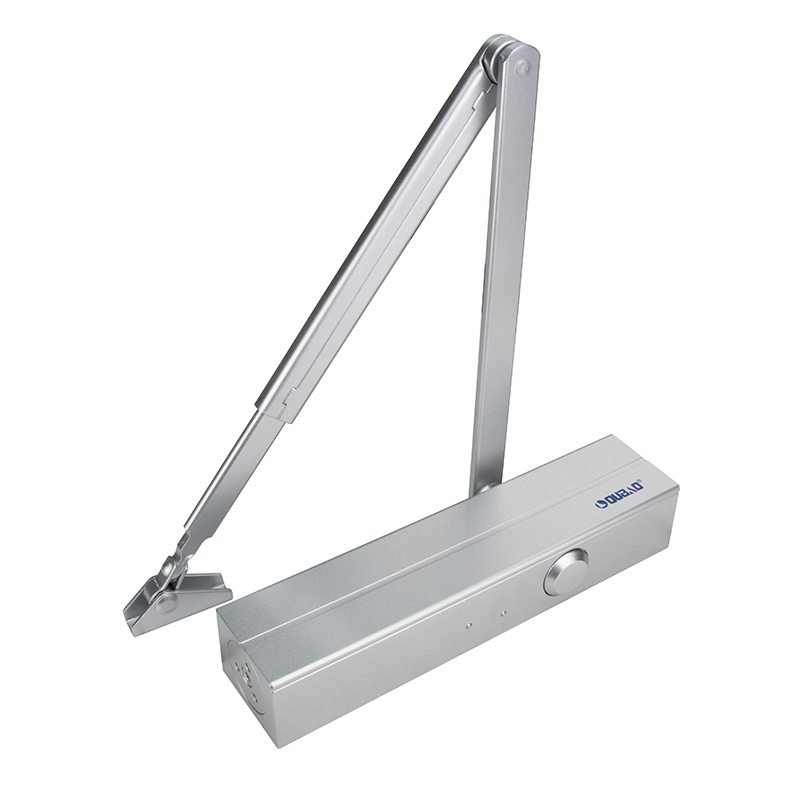
- Closing ForceEN 2-6 or 1-5
- Body Dimensions263 mm (L) * 60 mm (W) * 47.5 mm (H)
- Footprint100 mm * 43 mm
What Makes a Door Closer Fire-Rated?
A fire-rated door closer must:
- Be tested as part of a complete fire door assembly
- Maintain full closing function under high temperatures
- Use materials resistant to heat and deformation
- Deliver consistent latching force from any angle of opening
Why Certification Matters for B2B Buyers
Certified products increase inspection approval rates, reduce project risk, and protect the buyer’s liability position. A non-certified closer on a fire door voids the entire door assembly’s fire rating.
Types of Door Closers for Fire-Rated Doors
Surface Mounted Door Closers
The most widely specified type globally. Mounted on the door face or frame, these units are straightforward to install, adjust, and maintain. OUBAO surface-mounted units use zero-leakage hydraulic technology with 0.01mm precision pistons, delivering consistent damping performance down to -40°C.
Applications: Commercial buildings, schools, hospitals, industrial facilities.
Concealed Door Closers
Installed within the door leaf or frame, concealed closers provide a clean architectural finish with no visible hardware when the door is closed. These units carry a higher installation cost and require more precise fitting.
Applications: Hotels, executive offices, high-end retail interiors.
Floor Spring Door Closers
Set into the floor beneath the door, floor springs support heavy doors and allow double-action opening. High load capacity makes them the standard for glass fire doors and busy commercial entrances.
Applications: Glass fire doors, shopping centers, commercial lobbies.
Fire-Rated vs Standard Door Closers
| Feature | Fire-Rated Closer | Standard Closer |
| Certification | Required | Not required |
| Heat Resistance | High — tested to UL 10C | Limited |
| Positive Pressure Testing | Mandatory | Not applicable |
| Safety Role | Critical — life safety component | General use |
| Compliance | Mandatory on fire doors | Optional |
| Cycle Life Rating | 2,000,000+ cycles | 500,000 cycles |
| Thermal Stability | -40°C to +50°C | -10°C to +35°C |
Using a non-fire-rated closer on a fire door voids fire certification, creates legal liability, and causes project failure. The distinction is not technical preference — it is a compliance requirement.
How To Choose The Right Fire Door Closer
Door Size and Weight
Closers are rated by closing force using EN size classification:
- EN 2–3 — Light interior doors
- EN 4–5 — Standard commercial doors
- EN 6–7 — Heavy industrial and fire-rated doors
An undersized closer fails to latch. An oversized closer creates accessibility problems and accelerates hardware wear.
Fire Rating Compatibility
Match the closer to the door’s fire resistance rating:
- 60-minute fire doors
- 90-minute fire doors
- 120-minute fire doors
- 180-minute fire doors
Traffic Frequency
High-traffic environments demand heavy-duty construction and high cycle ratings. OUBAO Grade 1 industrial closers carry a 2,000,000-cycle life rating — the correct specification for corridors, stairwells, and hospital wings where doors operate continuously.
Functional Features
- Backcheck — Absorbs kinetic energy to prevent door slamming against the wall
- Delayed action — Slows closing speed for accessibility compliance
- Adjustable sweep and latch speed — Ensures secure latching every cycle
- Hold-open — Electromagnetic only on fire doors; must connect directly to the fire alarm system
Common Mistakes in Fire Door Closer Selection
Using non-certified products — The most serious error. Non-certified hardware fails inspection and voids fire ratings.
Incorrect EN force size — Too weak and the door does not latch. Too strong and the door becomes difficult to open, creating accessibility violations.
Improper installation — Arm geometry misalignment directly affects closing speed and latching performance. Sloppy installation defeats precision hardware.
Unauthorized mechanical hold-open devices — Fire doors cannot be held open by mechanical means unless the device connects to the fire alarm system. Mechanical door stops on fire doors are a code violation.
Ignoring maintenance — Even certified hardware fails without regular inspection. NFPA 80 requires annual fire door assembly inspections.
Frequently Asked Questions
Are door closers required on all fire-rated doors?
Yes, in most cases. Fire doors must be self-closing and self-latching under building codes in North America and Europe. A door closer is the mechanical device that delivers that function. The only exception is automatic-closing doors tied to fire alarm systems, which use electromagnetic hold-open devices that release on alarm activation.
Can a standard door closer be installed on a fire door?
No. Only closers certified under the applicable fire standard — UL 10C in North America, EN 1154 in Europe — are compliant on fire-rated assemblies. Installing a non-certified closer voids the fire rating of the entire door assembly and creates direct legal liability.
How do I select the correct door closer size for a fire door?
Base the selection on door weight, door width, and traffic frequency. The EN size classification runs from EN 2 for light doors to EN 7 for heavy industrial fire doors. For fire door applications in high-traffic corridors, EN 4 through EN 7 covers the majority of commercial specifications. When uncertain, size up — an undersized closer that fails to latch is a compliance failure.