


The cheapest hardware is always the one a facility replaces twice. Specifying the wrong door closer grade for a high-traffic entrance does not just create a maintenance problem — on a fire-rated door assembly, it creates a life-safety liability. A failed seal in a hospital corridor at 2 a.m. is not a maintenance ticket. It is a breach of the fire envelope.
This guide covers what ANSI/BHMA A156.4 grading actually means, which grade belongs on which door, and why a UL listed door closer is non-negotiable the moment a fire-rated opening is involved.
How Are Door Closers Graded for Commercial Use?
Door closers are graded under ANSI/BHMA A156.4 across three tiers based on minimum cycle count, piston tolerance, and structural durability. Grade 1 requires 2,000,000 cycles, Grade 2 requires 1,000,000, and Grade 3 requires 500,000. Traffic volume determines the grade — specifying below the threshold for the environment guarantees premature failure.
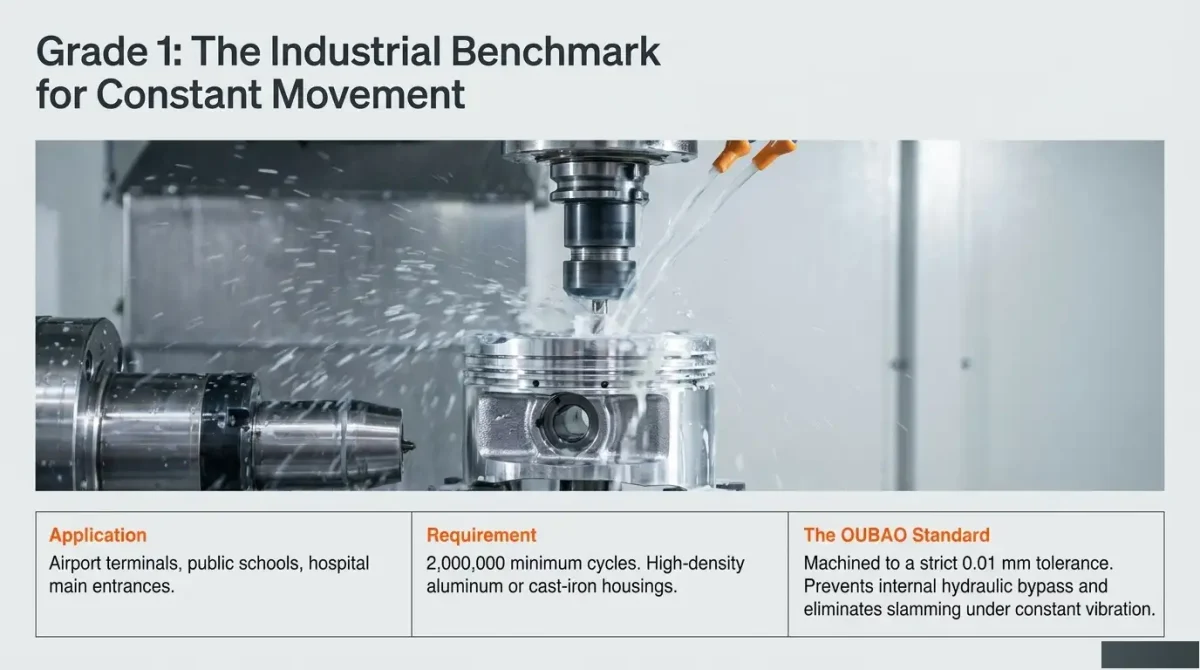
Grade 1 — Industrial Benchmark
Airport terminals, public schools, hospital main entrances: any door that never stops moving needs Grade 1. OUBAO machines Grade 1 pistons to a 0.01 mm tolerance to prevent internal hydraulic bypass — the failure mode that makes inferior closers lose closing force and start slamming within months of installation. High-density aluminum or cast-iron housings handle constant vibration and door weight without cracking.
Grade 2 — Standard Commercial
Retail stores, interior office corridors, and mid-range commercial fit-outs fall into Grade 2. The 1-million-cycle rating handles consistent daily traffic without the overhead of an industrial specification. It is the right balance when usage is steady but not extreme.
Grade 3 — Light Duty Only
Grade 3 suits office doors that stay closed most of the day. Anywhere beyond that, the 500,000-cycle limit becomes a cost problem fast. Installing Grade 3 on a main entrance produces early seal failure, oil leaks, and a replacement bill that erases every penny saved on the original hardware.
Grade Performance Comparison
| Feature | Grade 1 — Industrial | Grade 2 — Commercial | Grade 3 — Residential |
| Minimum Cycle Count | 2,000,000 | 1,000,000 | 500,000 |
| Piston Tolerance | 0.01 mm | 0.03 mm | 0.05 mm |
| Piston Material | High-Density Steel | Standard Steel | Alloy Steel |
| Temp. Stability | -40°C to +50°C | -20°C to +40°C | -10°C to +35°C |
| Warranty (OUBAO) | 5 Years | 3 Years | 1 Year |
| Lead Time | 35 Days | 35 Days | 35 Days |
Why a UL Listed Door Closer Is Mandatory on Fire Doors
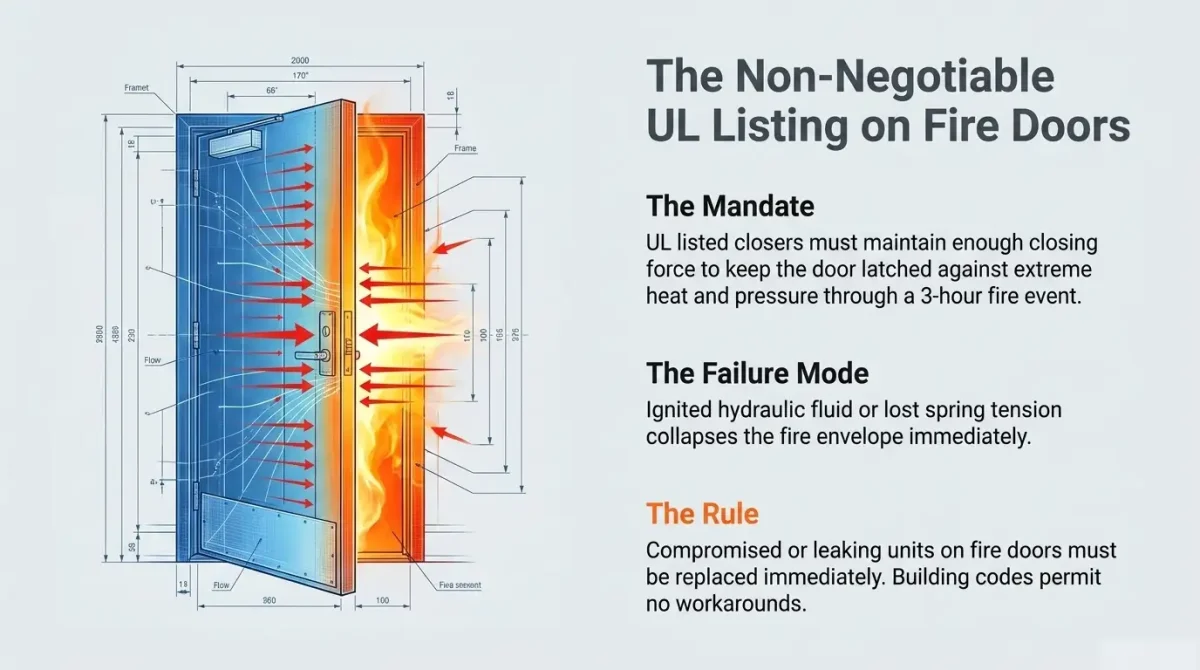
A UL listed door closer replacement is tested to stay functional through a 3-hour fire event — maintaining enough closing force to keep the door latched against heat and pressure. If the hydraulic fluid ignites or the spring loses tension, the door fails to close and the fire envelope collapses. Building codes do not permit alternatives on fire-rated openings.
When a closer on a fire door starts leaking oil or losing closing force, replace it immediately. An uncertified or compromised unit on a fire-rated door assembly puts occupants at risk and creates a compliance liability that falls directly on the facility manager. There is no workaround.
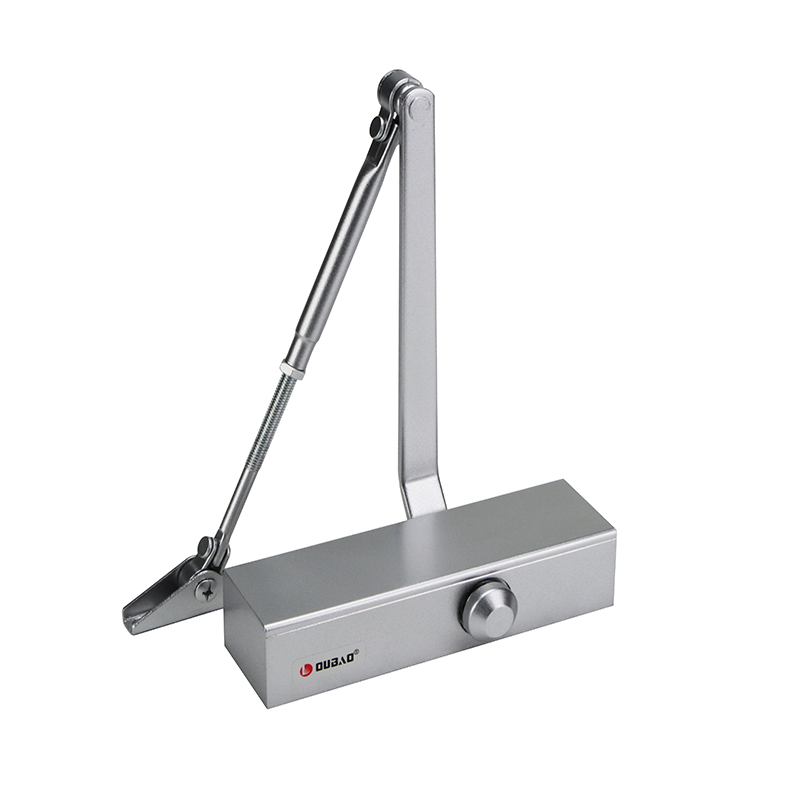
- Closing Force2、3
- Body Dimensions180 mm (L) * 51 mm (W) * 39 mm (H)
- Footprint60 mm * 38 mm
Where Most Hydraulic Door Closer Installations Go Wrong
Arm geometry is the most common failure point. A hydraulic UL-listed door closer installation requires the arm to sit at exactly 90 degrees to the door face when closed. Any deviation creates lateral pressure on the hydraulic seals, which causes uneven wear, oil leaks, and premature failure — usually within the first year on a high-traffic opening.
OUBAO supplies mounting templates with every unit to set the correct arm geometry automatically. Once mounted, technicians calibrate sweep speed and latch speed independently using the dual-valve system. That separation of the main closing arc and final latch moment eliminates the common problem of a door that closes quietly but fails to engage the latch under load.
How OUBAO Controls Quality from Metal to Finish
Every production stage — die-casting, precision machining, hydraulic assembly, painting — happens inside OUBAO’s 106,000 m² single-site facility. That vertical integration produces full batch traceability and supports the contractual 35-day lead time on global orders. No third-party component suppliers means no inter-supplier handoffs where batch inconsistencies originate.
OUBAO’s hydraulic fluid maintains stable viscosity from -40°C to +50°C. In standard closers, cold weather thickens the fluid and leaves doors hanging open; summer heat thins it and doors slam. OUBAO controls the fluid chemistry in-house, so performance stays consistent from a Scandinavian winter to a Gulf Coast summer. For coastal and offshore environments, the painting and plating processes exceed international salt-spray requirements — because a corroded arm on an offshore platform causes operational downtime, not just an inconvenience.
Frequently Asked Questions
What is the minimum order quantity (MOQ) for bulk door control supply?
The MOQ depends on the specific product model and customization requirements. It typically ranges from 300 to 1000 units. This scale allows us to maintain factory-direct pricing while ensuring each unit meets our 6S quality management standards.
How long is the standard lead time for global project orders?
Our vertically integrated production facility allows for a guaranteed 35-day lead time on all standard orders. Because we handle everything from die-casting to painting in-house, we eliminate the delays caused by third-party component suppliers.
Are free samples available for technical evaluation?
Yes, we provide free samples for project evaluation. We encourage engineers and facility managers to assess the build quality, hydraulic stability, and finish of our hardware before placing a bulk order.