
Quick Answer
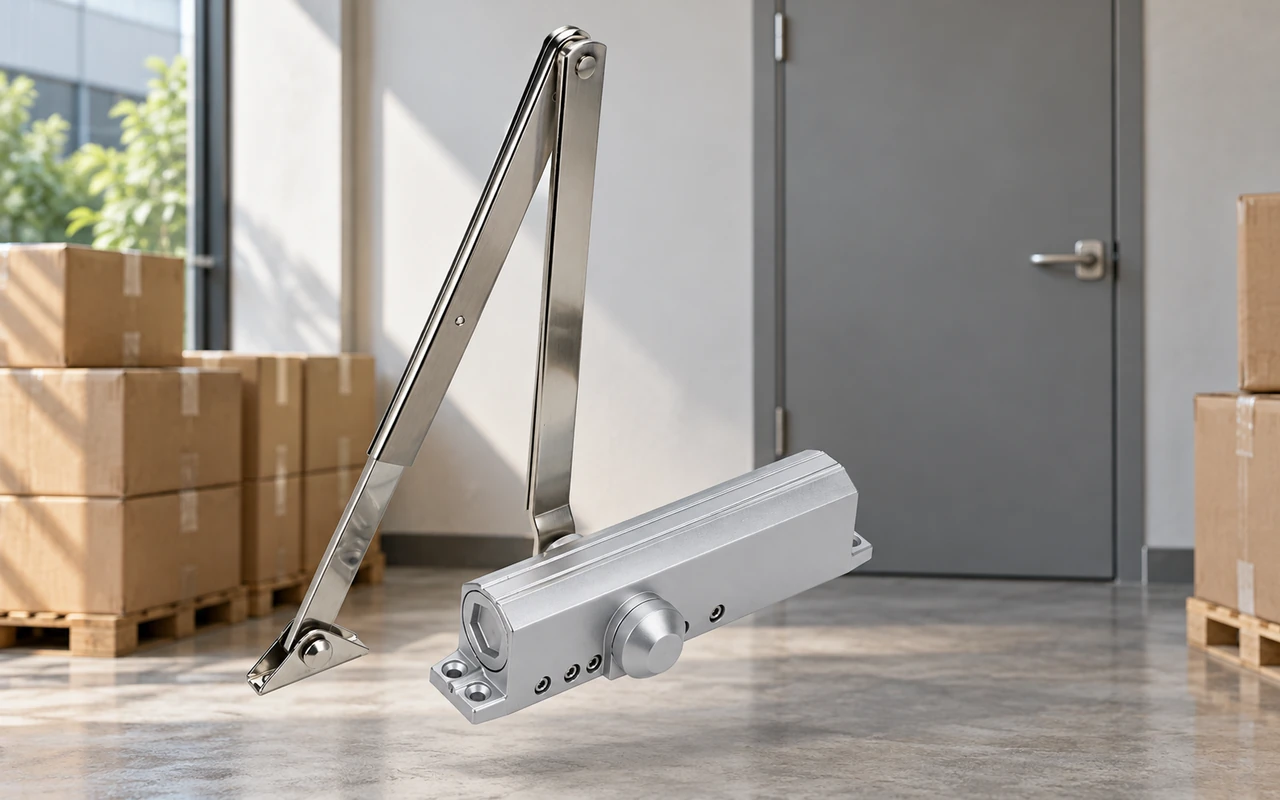
A heavy duty door closer is not one product — it is a closer built for heavy, high-traffic doors. Two things separate it: a cast iron body instead of die-cast aluminium (aluminum), and a spring rated for that load. For OEM projects, compare suppliers on seven RFQ checks: door data, body and power size, standard versus optional functions, model-level certificates, arm list, ordering terms, and batch QC evidence. OUBAO builds heavy duty and budget closer ranges in house, so buyers can match a heavy duty door closer to the door.
This guide walks through those seven checks, shows what a heavy duty door closer must prove on its datasheet, and flags where cast iron and industrial door closer specs go wrong.
What Separates a Heavy Duty Door Closer From a Standard One?
Is it the material, the spring, or the test rating?
All three, and buyers usually check only one. Material decides how long the body lasts. Spring and power size decide how much door the closer can pull shut. The test rating decides whether you can prove it to a specifier.
A heavy duty door closer earns the label in all three places. On its own the phrase is marketing; it becomes a fact when a standard attaches to a specific model.
Does a cast iron door closer really last longer?
A cast iron door closer body is denser and less prone to distortion than die-cast aluminium or zinc. On a heavy leaf slammed repeatedly, that matters: the cylinder holds its shape, the mounting threads survive, and the closer is less likely to leak hydraulic oil early.
Aluminium and zinc bodies are lighter and cheaper, and adequate for medium-duty interior doors. For a distributor, the trade-off is lower upfront cost against more replacement claims and callbacks.
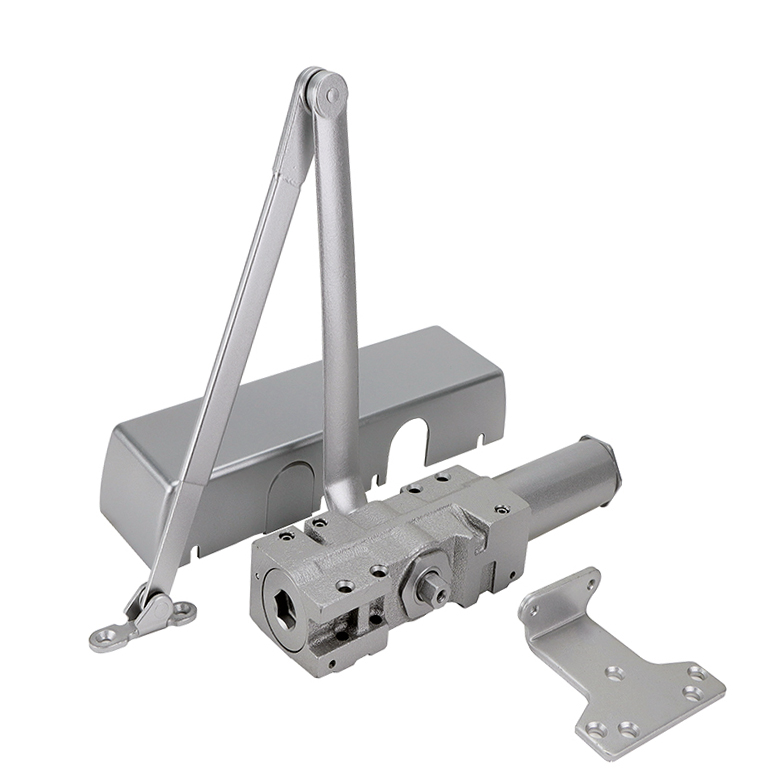
The OB03 heavy-duty cast iron door closer is OUBAO’s cast iron option, listed with separate BC, DA, BCDA and T variants, so function can be matched without changing the body.
- The OB03 Series is designed for various door types, including wooden and metal doors. Yes, the OUBAO OB03 Series features a non-handed design.
What do heavy duty grades mean in plain English?
North American closers are graded under ANSI/BHMA A156.4. Grade 1 is the top durability class, usually linked to about two million test cycles; Grade 2 around one million; Grade 3 around 500,000. In Europe, EN 1154 sets closing-power sizes and test requirements instead.
Both describe a tested model, not a whole catalogue. Our ANSI/BHMA Grade 1 vs Grade 2 guide explains the difference, and the door closer collection shows how the ranges sit side by side.
Which Heavy Duty Door Closer Fits an OEM Project?
When is an industrial door closer the right choice?
An industrial door closer suits openings that are heavy, wide, wind-exposed, or used by hundreds of people a day — factory units, warehouse loading areas, hospital corridors, school entrances and exterior commercial doors.
Two functions earn their place here. Backcheck cushions a door thrown open hard. Hold-open, where permitted and confirmed for the fire strategy, stops a busy door fighting traffic. Both are often options rather than defaults, so state them per model.
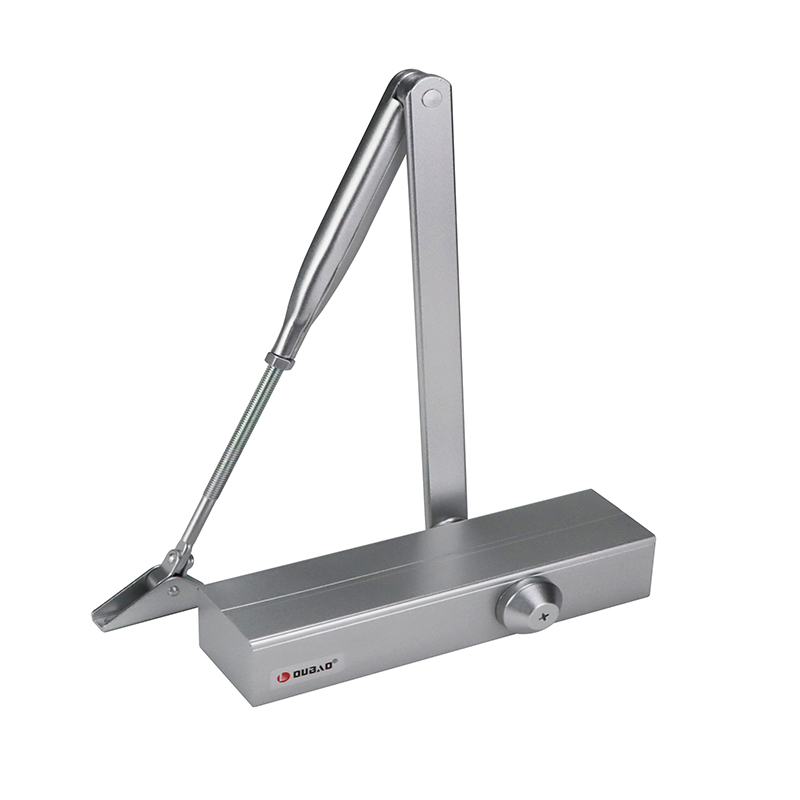
Surface-mounted bodies stay the practical default where installers must reach valves later. The 204 heavy duty square door closer is a CE-marked heavy-duty square-body series listed with BC and SL variants — a shape often specified for heavy commercial doors.
- The 204 series is designed for various door types, including wooden and metal doors. Yes, the OUBAO 204 series features a non-handed design.
Does the mounting style change the size you need?
Yes, and it causes returns. Regular, parallel, top jamb and track mounting each change the arm geometry, so the same body may not deliver the same usable force in every position. On an industrial door closer, confirm the power size for the position you are specifying.
The 7 RFQ Checks Before You Compare Prices
1. Have you sent the door data, or just a product name?
Share leaf width and weight, mounting position, frame material, interior or exterior, traffic level, and any fire or accessibility requirement. Power size works as a maximum for both width and weight, so the heavier requirement wins. For a heavy duty door closer, a quotation built without door data is a price, not an offer.
2. Is the body material and power size written on the quote?
Ask for body material, mechanism type (rack-and-pinion or cam action) and the power size range, against the exact part number. If the model you are buying is a cast iron door closer, the quotation should say cast iron, not “metal”. Adjustable models reduce SKU count, but the force band must still reach the heaviest door on the schedule.
3. Which functions are standard, and which are options?
Sweep speed, latching speed, backcheck, delayed action, hold-open arms and slide track are often optional or built to order. Two suppliers quoting the same heavy duty door closer can be quoting different builds, which is usually where a price gap comes from. Put every function on its own line of the RFQ.
4. Do the documents cover this exact model and market?
OEM buyers most often regret skipping this check. A family-level UL listing, CE marking or ANSI/BHMA report does not cover every configuration, finish or door assembly. Ask for the document number, then confirm the certificate model number matches the quote. For fire doors, the approval belongs to the tested assembly, not the hardware alone. OUBAO publishes its documents through the certificates page, and the scope for each quoted model needs written confirmation.
5. Does the arm and bracket list match the mounting?
An industrial door closer without the right bracket cannot be installed. Check whether the arm is included, whether a parallel-arm bracket or drop plate is needed for a thin top rail, and whether hold-open or track versions ship with different components. Missing brackets are a site stoppage, not a paperwork problem.
6. Are the ordering terms clear for both standard and custom?
Confirm MOQ per model and per finish, sample cost and whether it is credited to the first order, production lead time and its starting point, private-label options such as logo method and packaging artwork, and export packaging. OUBAO runs private-label programs through its OEM and ODM process, where door weight, power size, functions, finish and packaging are agreed before tooling and production.
7. How will the factory prove consistency between batches?
Ask what happens between order one and order five. OUBAO combines incoming-material checks, in-process control, functional testing and MES-based batch traceability, with endurance and corrosion testing in its own CNAS-accredited laboratory; the quality and manufacturing pages set out that workflow. For an industrial door closer, request test reports for the quoted model, agree a pre-shipment inspection standard, and keep a golden sample signed off by both sides.
FAQ
What does “heavy duty” mean if there is no grade on the datasheet?
Treat it as unproven until a document attaches to a model. A defensible heavy duty door closer claim comes with a body material, a power size range, and a test report or grade covering that exact configuration.
Is a cast iron door closer always better?
No. A cast iron door closer suits heavy, high-traffic doors where distortion and early oil leaks are the real risk. On a medium-duty interior door, an aluminium or zinc body costs less and does the job.
Can one heavy duty door closer cover a whole project?
Rarely, and it usually costs more than it looks. Door weights, widths and mounting positions vary across a building, and one oversized model forces doors open too hard. A small core range with adjustable force is usually the better stock decision.
Seven Checks, One Clear Brief
A heavy duty door closer is a claim until a document supports it. Buyers who field fewer warranty claims send door data, lock body material and power size to a part number, confirm documents at model level, and agree QC and ordering terms before the PO goes out.
Send OUBAO your door schedule, target market, required functions, documents and estimated quantity. Our team will confirm a suitable heavy duty door closer configuration, the matching arm and bracket list, and a model-specific quotation.