Quick Answer
With a private-label heavy duty door closer, buyers can usually customize power size and closing speed, finish and cover, arm type, back check and delay action, mounting style, packaging and branding. What rarely changes is the certified core: the body, the hydraulic circuit and any listed performance value. OUBAO builds these platforms in-house, so a private-label range can start from an existing adjustable door closer series instead of funding a new design from scratch.
The real question is not whether a supplier offers customization — most say they do — but which parts can change without breaking the certification, the tooling or the delivery date. This guide covers the options buyers control and the checks to run before signing a private-label quote.
What Can You Customize on a Private-Label Heavy Duty Door Closer?
Customization comes in three layers, and knowing which one you are in prevents most quotation surprises:
- Catalog options — choices the supplier already builds, such as finishes and arm types.
- Configured options — the same body with a different spring set, branding or packaging.
- New tooling — a new casting or mechanism that changes the product itself.
The first two are fast. The third is a development project that changes lead time, minimum order and often the certification route.
Which adjustments can you specify on the same closer body?
The most valuable customization on an adjustable door closer is closing force. Power size is simply how hard the closer pushes the door shut, and it has to match the leaf weight and width. On an adjustable door closer you set it with a valve, so one SKU covers several door weights instead of forcing you to stock five fixed sizes. The 9016 adjustable power door closer adjusts from power size 1 to 6 and lists a door weight range of 15–150 kg with widths up to 1400 mm.
Closing and latching speed work the same way. Two valves let the installer tune the sweep and the final latch, which is what stops a door from slamming. Back check, which cushions the door as it swings open, and delay action, which holds the door briefly for trolleys and wheelchairs, are normally specified as options on the same body.
What can be changed on the outside — finish and branding?
This is where private label is most visible. Common standard finishes are silver, white and black, and surface treatments can be adjusted for a brand or a market. Buyers also specify printed or laser logos, cover style, retail packaging, carton artwork, manuals and barcodes.
These are order-line items rather than design changes, which makes them the cheapest way to create a branded product. OUBAO’s OEM/ODM page lists surface treatments, packaging and spring strength as discussion points — a practical checklist when you build your own specification sheet.
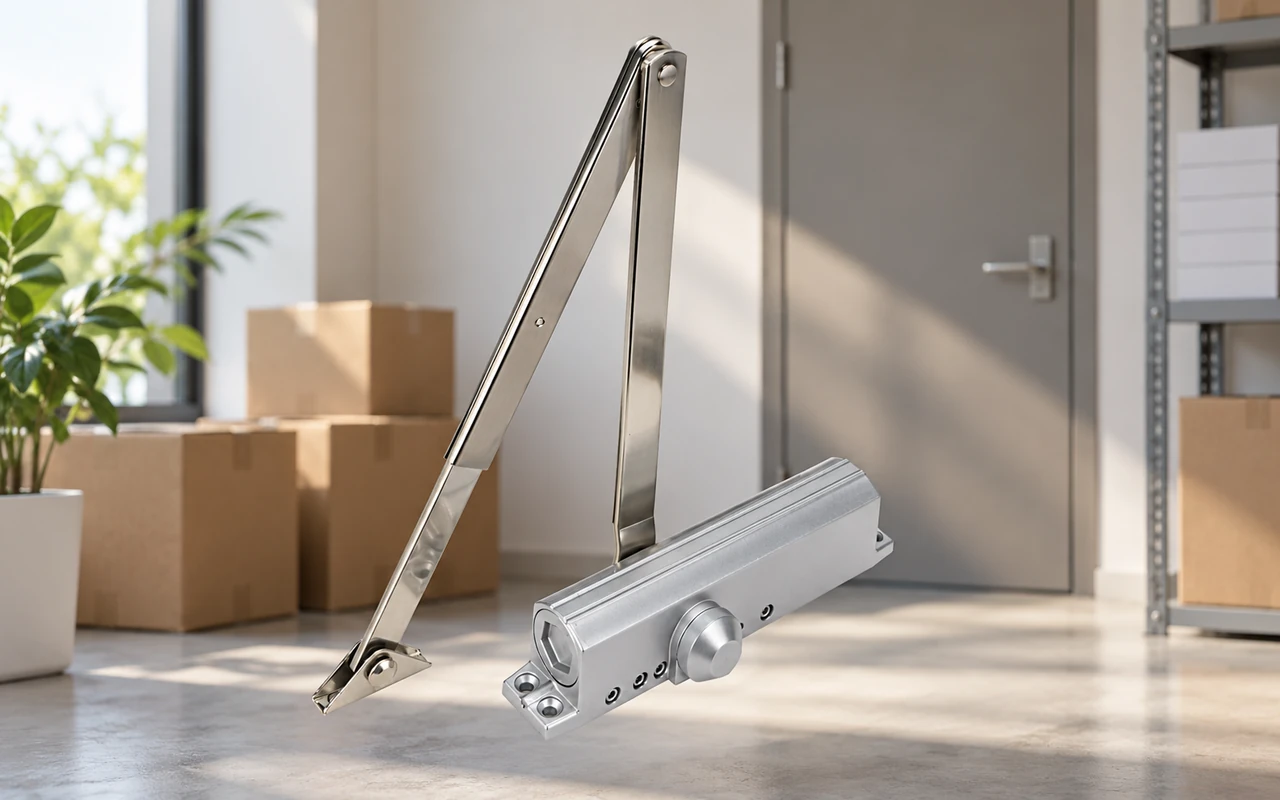
How do arms and functions change the order line?
Arm choice decides how the closer mounts and what the installer can do on site:
- Standard arm — the common pull-side installation.
- Parallel arm — used when something blocks the space above the door; the P.A. bracket is often supplied on request rather than as standard.
- Top jamb — body on the frame header.
- Slide arm — for specific door and frame combinations.
- Hold-open arm — keeps the door open past a set angle, a frequent requirement in schools and clinics.
Each option is a separate line item, and “on request” means it must appear on the purchase order. Buyers who assume it ships standard meet site problems later; the hold-open versus non-hold-open guide explains where the function belongs.
How far can you push the door fit?
Door weight and width set the ceiling. OUBAO’s OEM/ODM sheet lists door adaptation up to 300 kg and 1600 mm for suitable series, but a specific series only covers its own printed range — you cannot exceed it by choosing a heavier spring. Concealed models suit clean facades but need door preparation; surface-mounted models are easier to install and adjust. The full door closer range shows how these formats sit side by side. Non-handed designs let one unit serve left- and right-hand doors and cut the SKUs a distributor stocks.
What Can You Not Change Without Re-Testing?
Does customization affect UL, CE or ANSI/BHMA listings?
Yes, if you change a listed component. Certificates cover a specific model and configuration. Switching the hydraulic circuit, a structural casting or the arm geometry can move the product outside the tested scope, while cosmetic changes such as packaging or a printed logo normally stay inside it. Ask whether your change touches a tested part, and get the answer in writing before you commit to a container. Certification is also market-specific — a listing that serves one destination may not satisfy another.
Which documents should come with a customized order?
For each destination market, request the current certificate or test report for the exact model and configuration, plus drawings and installation instructions. OUBAO lists certification per model — the 9016, for instance, is shown with UL, UL10.C and ANSI 156.4 Grade 1 — and the certificates page is where scope should be checked.
How Does a Private-Label Program Run?
From RFQ to prototype approval
A useful RFQ includes the door schedule, leaf weight and width, mounting style, required functions, finish, branding, target market, required documents and estimated volume. That lets the supplier name candidate series and flag anything needing development. OUBAO’s process moves from market requirements to prototypes and testing before production, and the in-house mold and manufacturing workflow is what shortens that loop when a new part is genuinely needed. Once the sample is approved, the signed drawing becomes the master specification, so confirm that the production drawing, the approved sample and the purchase order all match.
MOQ, sample terms and lead time vary by model and order type, so confirm them in the written quotation rather than a brochure, and check when the delivery clock starts.
What Should Buyers Confirm Before Signing a Private-Label Quote?
- The exact model code and configuration the price covers.
- Power size range and door weight/width limits for that configuration.
- Which functions are standard and which are options or on request.
- Finish, branding artwork and packaging specification.
- Certificate or report scope for each destination market.
- Minimum order, sample terms, delivery point and lead-time start date.
Why Buyers Build Private-Label Ranges With OUBAO
OUBAO has manufactured door-control hardware since 1987 and works from a 106,000 m² manufacturing base in Lishui, Zhejiang, where die casting, CNC machining, assembly, oil filling and surface finishing run under one roof. The range covers surface-mounted, concealed, cam-action and guide-rail closers, plus magnetic locks and related access-control hardware. The door closer collection shows how the OEM/ODM programs are structured.
For private-label buyers, the useful part is the development path: an in-house mold workshop and adjustable door closer platforms that already cover a wide door-weight band, so you can customize branding, finish, packaging and functions instead of funding a new design.
FAQ
What is the minimum order for a private-label door closer?
It depends on the model. OUBAO’s OEM/ODM programs start from 300 sets, with the exact minimum confirmed for your configuration in the quotation.
Can I put my own brand on a heavy duty door closer?
Yes. Printed or laser logos, cover style, retail packaging, carton artwork, manuals and barcodes are the usual branding items, and they are added to the order line rather than the product design.
Does a customized closer keep its certification?
Only if the change stays inside the tested configuration. Cosmetic and packaging changes usually do; changes to the body, hydraulic circuit or arm geometry may need re-testing.
Final Thoughts
Private-label customization on a heavy duty door closer is mostly about how much of the product you can specify without touching the certified core. Power size, functions, arms, finish, branding and packaging sit inside that space, and they are enough to build a distinct brand range. Anything beyond it is a development project, and should be quoted as one.
If you are building a private-label range, share the door schedule, target market, required functions, finish and estimated volume with OUBAO so the team can confirm the series, documents and order terms in writing.