


Quick Answer
A door closer size chart matches three numbers: leaf width, leaf weight and power size. Power size is the spring force a closer delivers, normally EN 1 to EN 6, and it works as a maximum rating rather than a target. I size to the heavier of the two measurements, then confirm body size and mounting. OUBAO publishes width, weight and power size for every sub-model in its door closer range, so you can check real numbers instead of guessing from a series name.
If you buy door closers for resale or specify them for projects, this guide shows how I read a size chart, where the chart stops being useful, and what to put in an RFQ so the quotation comes back right the first time.
What Can a Door Closer Size Chart Tell You — and What Can’t It?
What does “power size” mean in plain English?
Power size is spring strength. A size 3 closer has a weaker spring than a size 5, so it can only pull a smaller, lighter leaf back into the frame. European closers are graded EN 1 to EN 7; in North America the same idea appears as ANSI/BHMA sizes 1 to 6. Many models adjust across two or three sizes, which is why a datasheet often shows a range such as EN 3–5 instead of one fixed number.
Which numbers must come from your door schedule?
A size chart cannot tell you the door thickness, frame type and reveal, hinge side, or the clear opening your site needs. It also cannot tell you whether the assembly is approved for a fire door, or how the leaf behaves in wind. Take those from your door schedule and project documents, then use the chart only for spring strength.
How Do I Match Door Width and Door Weight Together?
This is the door closer size chart I treat as a starting point. Both columns are maximums, so compare them against your actual leaf.
| Power size | Maximum leaf width | Maximum leaf mass |
|---|---|---|
| 1 | 750 mm | 20 kg |
| 2 | 850 mm | 40 kg |
| 3 | 950 mm | 60 kg |
| 4 | 1,100 mm | 80 kg |
| 5 | 1,250 mm | 100 kg |
| 6 | 1,400 mm | 120 kg |
| 7 | 1,600 mm | 160 kg |
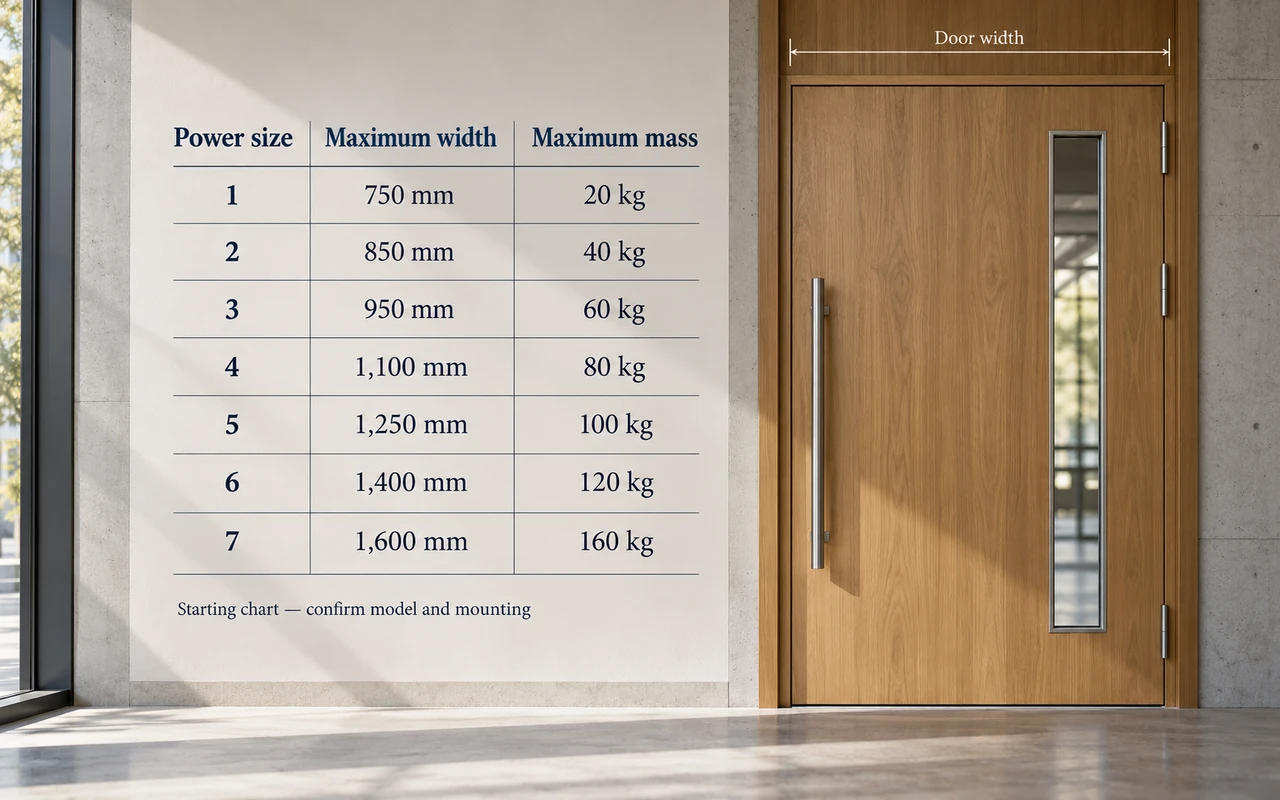
You can browse the door closer category to see how these sizes are distributed across series.
What if width and weight point to different sizes?
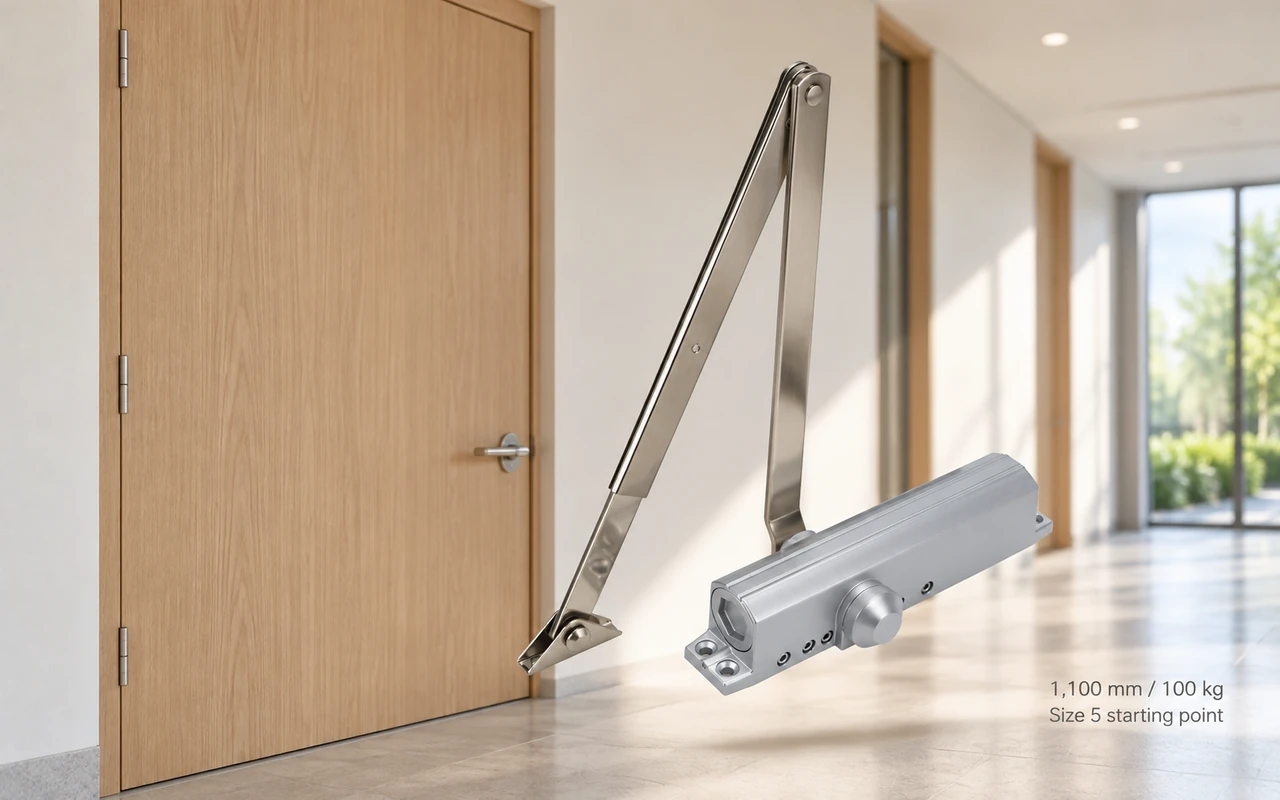
Go with the heavier requirement. A 1,100 mm leaf that weighs 100 kg needs size 5 for the mass, even though size 4 already covers the width. A door closer size chart gives you the opening size, not the final setting. When a door sits close to a boundary, I step up one size and use the adjustment valve to bring force down at handover. Step up too far and the door becomes hard to push open, which matters on entrances that have to stay accessible.
Why is “heavy duty” a separate question from size?
Size 6 does not make a closer heavy duty. Heavy duty describes how long the unit lasts under constant traffic, and it usually involves a higher cycle rating and a stronger housing, such as cast iron. Keep the two ideas apart: size tells you whether the closer can control the leaf, duty tells you how often you will replace it. How door closers are graded explains the cycle thresholds behind those ratings.
How Do I Choose Power Size and Mounting Configuration?
Does mounting change the power size?
Yes, and it is easy to miss. On OUBAO’s 204 Series, the standard arm gives sizes 2–4 with leaves up to 1,100 mm, but the same body on a slide arm is published as size 3 with a 950 mm limit. Standard, parallel-arm, top-jamb and slide-arm installations change the arm geometry, so the usable power size can drop. Before comparing prices, make sure you are comparing the same mounting method.
Which body dimensions should I check?
The spring does not care about the cover, but your frame does. I confirm overall length, width and height of the body, plus the mounting footprint. The 500 Series is a useful example — body length grows from 186 mm to 248 mm as power size rises, so a size 5 unit needs more frame space than a size 2. Concealed work is limited by the pocket already prepared in the door, so a slim body matters more there. The 1035 concealed closer fits a 37 mm body.
Closing speed is set on site after installation. Back check, sweep and latch valves adjust separately, and I walk through the sequence in our adjustment guide.
Worked Examples for Heavy Commercial Doors
Office corridor: 1,100 mm leaf, 80 kg, standard arm. Size 4 fits both numbers. The 504 in OUBAO’s 500 Series is published at size 4, 60–85 kg and up to 1,100 mm.
- This series is designed for various door types, including wooden and metal doors. Yes, this series features a non-handed design.
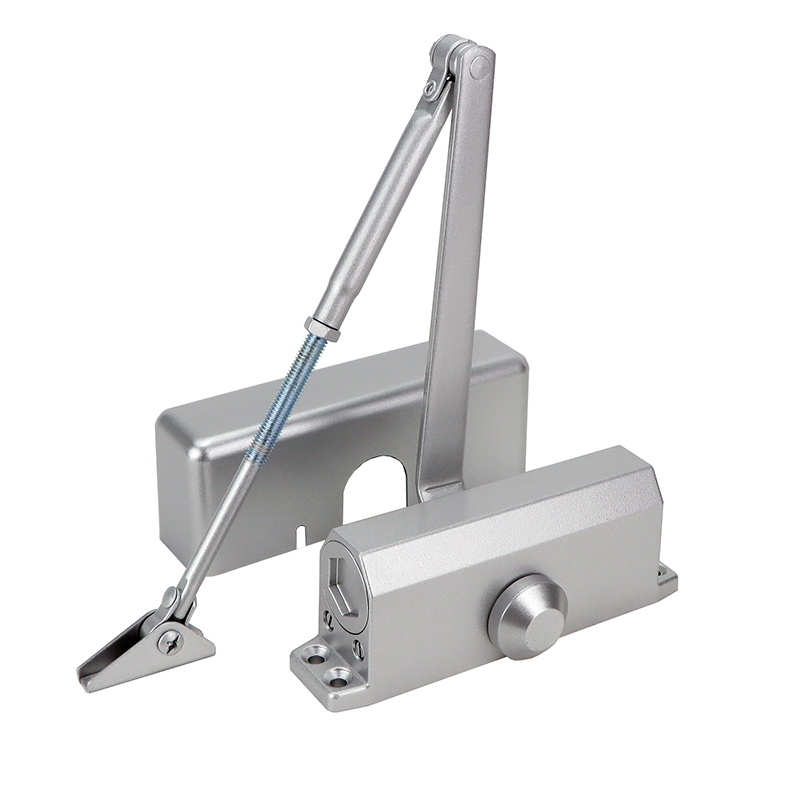
Main entrance: 1,450 mm leaf, 180 kg, metal door. This is where a heavy duty door closer earns its place. The OB03 Series covers power 1–6 for 15–150 kg and 750–1,400 mm, while OB03T is published at power 8 for 150–220 kg and widths from 1,400 mm upward. On the current datasheets, OB03BC carries UL, UL10.C and ANSI A156.4 Grade 1, and OB03T is listed without those marks — so I confirm certificates per sub-model, never per series.
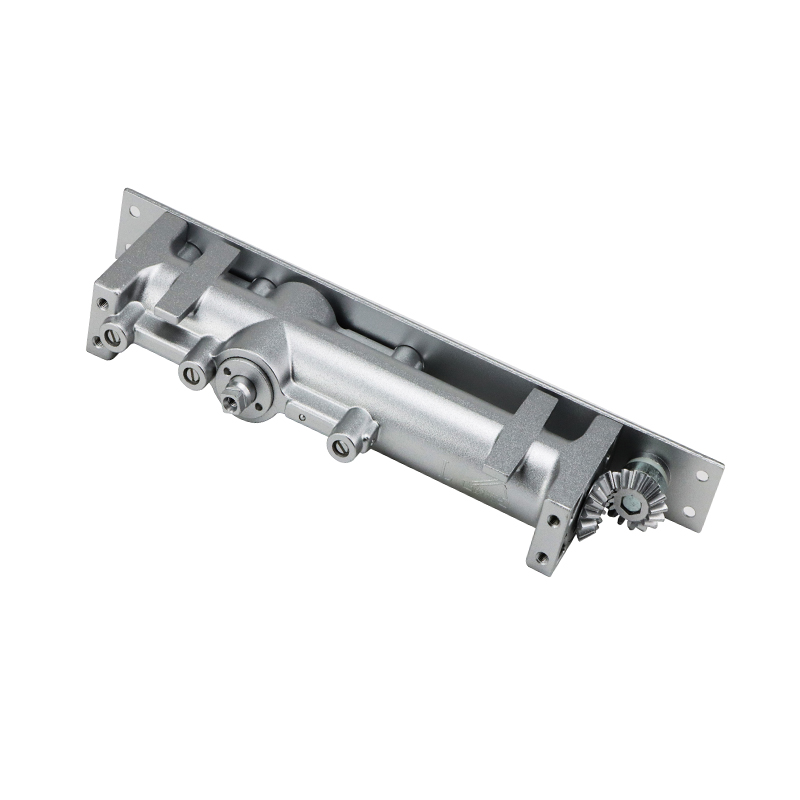
Hotel guest door: 1,000 mm leaf, 60 kg, concealed. An EN 3–5 adjustable concealed unit covers this and keeps the door face clean.
- The 1035 series is designed for various door types, including wooden and metal doors. It supports doors with a maximum width of 1250mm and a maximum weight of 100kg.
What Should I Send With an RFQ?
- Leaf width, height, thickness, weight and material.
- Frame type, reveal, hinge side and handing.
- Preferred mounting method, and any prepared pocket.
- Traffic level, environment and expected service life.
- Required functions: back check, delay action, hold-open, adjustable power.
- Target market and the approval documents your customer asks for.
- Quantity, finish, branding and packaging requirements.
With those details, I can confirm a model, the exact power size and the parts list instead of sending a catalogue and hoping it lands. For private-label and project orders, OUBAO’s OEM/ODM team works from the same brief.
FAQ
What size door closer do I need for a 900 mm door?
Width alone points to size 3, which covers 950 mm. Check the weight as well: if the leaf is heavier than 60 kg, move up to size 4. Width is the easier number to find, which is why so many undersized closers end up on heavy doors.
Is a heavier door always a bigger power size?
Usually, but two 100 kg doors can need different springs. A wider leaf has more leverage against the closer, which is why the chart tracks width and mass side by side. Wind, pressure differences and door seals add resistance too.
How do I know a heavy duty door closer is really heavy duty?
Ask for the cycle rating and the housing material on the exact model, then match both to the traffic the opening sees. A cast iron body with a Grade 1 cycle rating suits an entrance that never stops; a lighter housing is often enough for a back office door.
Can I use one closer series for every door in a project?
Sometimes, if the series is adjustable enough and covers your heaviest leaf. More often, buyers split a project across two or three series: cost-controlled closers on interior doors, higher cycle ratings at main entrances. Confirm certificates, arms and finishes per model before consolidating.
Sizing Comes Down to Two Numbers and One Check
Treat the door closer size chart as a starting point: match the heavier of leaf width and leaf weight, step up when a door sits near a boundary, then confirm mounting, body size and certificates for the exact model. That is the whole method, and it prevents most site problems and returns. Send me your door schedule with widths, weights and mounting notes, and OUBAO will confirm the power size and quote the right model.