Quick Answer
The cheapest quote from a door closer manufacturer in China is rarely the lowest total cost for a commercial door closer. Six checks decide the real number: whether the factory actually produces the closers, whether the model matches your door schedule, whether certification covers your exact SKU and market, whether the sample and QC plan can be audited, and what support, lead time and landed cost total. OUBAO, a China-based door closer manufacturer, opens all six to inspection.
For distributors, project buyers and private-label brands, this guide gives the questions to ask, the documents to request and a scorecard for comparing two suppliers on the same terms. Unit price stays on the sheet — it just stops being the only line on it.
What Do You Check in a Chinese Door Closer Factory Besides Price?
Why do buyers stop at unit price?
It is the easiest figure to compare. But a closer that leaks on a hotel corridor, or refuses to latch on a fire door, creates callbacks, replacements and freight — costs the quote never showed. The six checks below pull those costs back into the decision.
Which six checks matter most?
- Factory and production scope.
- Model fit with the door schedule.
- Certification by SKU and market.
- Sample approval and QC plan.
- Support, lead time and landed cost.
- A scorecard that turns the first five into one number.
Check 1: Is the Factory Really Producing the Door Closers?
What separates a real factory from a trading supplier?
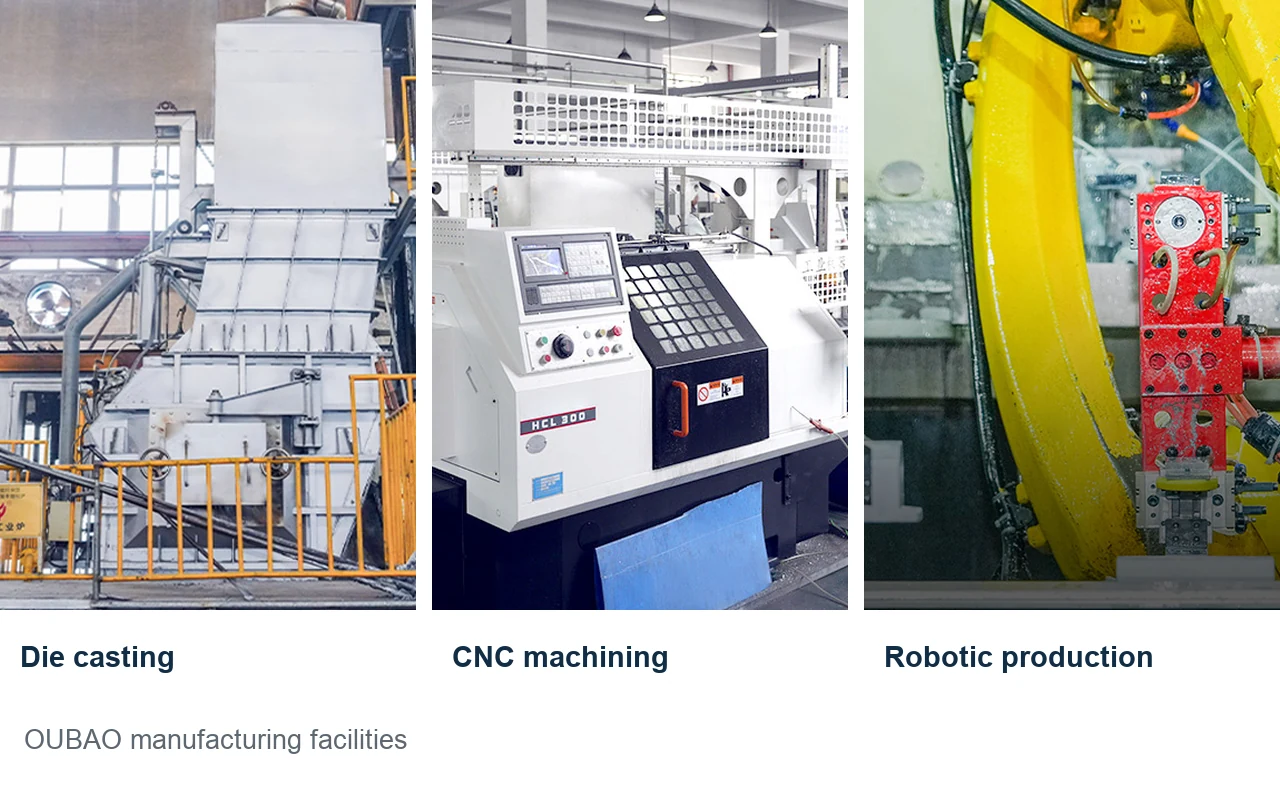
A trading supplier quotes a price for a commercial door closer and passes the order on. A manufacturer controls the processes that decide whether the product lasts. Ask what happens in-house: die casting, mold development, CNC machining, oil filling, assembly and finishing. OUBAO runs all of them under one roof across a 106,000 m² base, with 9 die-casting machines, 100 CNC machines and 25 robotic arms — see the manufacturing page.
What production evidence should you request?
- A live walkthrough of the process steps you care about.
- A machine list and realistic capacity for the line you are buying.
- Confirmation that springs, bodies and hydraulic oil are controlled, not just assembled.
- The range itself: surface-mounted, cam-action, concealed and guide-rail closers, compared in the door closer collection.
Check 2: Does the Model Match Your Door Schedule?
Which door details decide the model?
Commercial door closer selection starts with door weight and width, then mounting position, then the functions the opening must deliver. A model is “matched” only when the published range of the exact sub-model covers the leaf — a series name is not a specification.
Why do mounting and functions change the SKU?
Standard, parallel arm, top jamb and slide-arm installations use different brackets and arm geometry, so they do not all deliver the same usable power size. Functions behave the same way: back check, delayed action and hold-open are often options, not standard, so they belong on the purchase order.
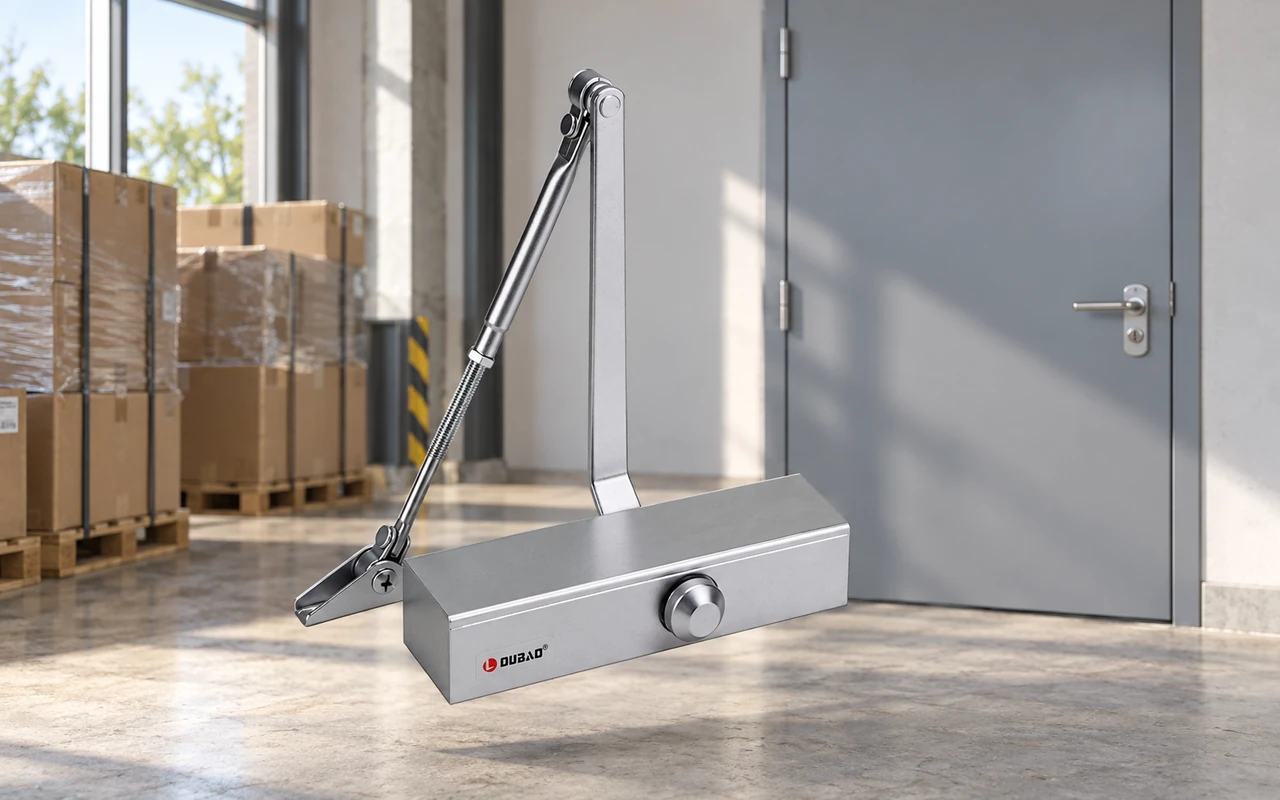
The 9016 adjustable power door closer is published at EN power 1–6, for door weights of 15–150 kg and widths up to 1,400 mm, with standard, parallel, top jamb and slide-arm installation. The 9016BC carries a back check; delay action and a hold-open arm are optional, and the unit is non-handed. Its parallel-arm bracket is supplied on request, so write that requirement down.
Check 3: Does the Certificate Cover Your Exact SKU and Market?
Why is a series-level certificate not enough?
A commercial door closer certificate is tied to a model, a configuration and a standard. A mark on a collection page does not automatically cover every sub-model or power size. Fire doors tighten this further: the document must match the tested leaf, the closer and the destination market.
Which documents should be on file before the deposit?
- The certificate and third-party test report for the exact model and market.
- The scope of that report: power sizes, mounting configurations, fire ratings and limits.
- The current datasheet and installation drawing for the sub-model.
- Grade evidence where required — the Grade 1 vs Grade 2 guide explains what each level tests.
OUBAO publishes CE, UKCA, UL, ANSI/BHMA Grade 1 and Warringtonfire Certifire certification, with third-party test reports available before you order. Read the scope against your project, starting from the certificate page.
Check 4: Can You Audit the Sample and the QC Plan?
What should the approved sample lock down?
Ask for a golden sample — one signed, dated unit kept as the production reference. It fixes door weight and width, power setting, mounting, arm type, finish, packaging and branding. Without it, small changes in springs, seals or valves reach you quietly.
How is batch consistency proven?
Separate sampling from screening. Ask how every unit is checked, then how the batch is tracked. Look for incoming-material analysis, in-process measurement of the piston bore, individual functional testing and traceable lot codes. OUBAO applies 6S management and MES traceability, and its CNAS-accredited laboratory runs endurance testing up to 2 million cycles — see the quality process. This door closer grading explainer is a useful companion read.
Check 5: What Do Support, Lead Time and Landed Cost Add Up To?
What is usually missing from a unit-price comparison?
- Tooling and mold cost for branded or custom parts.
- Sample and freight charges, and whether they are credited on the first order.
- Packaging specification, including private-label packaging.
- Spare arms, brackets and documents supplied per order.
- Duty, freight and any local approval cost.
- Warranty terms, and how a claim is handled.
How should lead time and MOQ shape the plan?
Published lead time is 30 days for standard orders and 35–45 days for custom production. MOQ is 300 sets, with no separate minimum for standard or private-label work. Confirm the counting start point in the quote — deposit cleared and artwork approved are very different. Our OEM and ODM team works from a door schedule and mounting requirement.
The Six-Check Supplier Scorecard
| Check | What to request | Pass signal |
|---|---|---|
| Production scope | Process and machine list | Key processes are in-house and visible |
| Door schedule fit | Sub-model datasheet per leaf | Published weight, width and power cover the door |
| Certification | Model-level certificate and report | Scope names your SKU, configuration and market |
| Sample and QC | Golden sample, check plan, lot codes | Every unit tested, batch traceable |
| Commercials | Landed cost, MOQ, lead time, warranty | Terms confirmed in writing, not implied |
| Scorecard | All five compared for two suppliers | Differences are documented, not argued |
FAQ
Is a lower unit price ever worth switching suppliers for?
Only when the other five checks still pass. A 5% saving on the piece price disappears after one callback, one replacement shipment or one unsold pallet.
Can I verify a Chinese door closer factory without visiting?
Yes. Pair a live video walkthrough of the line with the document pack — model-level certificates, test reports, drawings and a signed golden sample. The paperwork often reveals more than a short site visit.
How many samples should I approve before a bulk order?
One signed golden sample per configuration is enough, kept at the factory and matched against production. Approving extra units without a written record adds time, not control.
What lead time should I expect from a door closer manufacturer in China?
Published figures commonly run around 30 days for standard orders and 35–45 days for custom work. Confirm the counting start point and any peak-season buffer in your quotation.
Compare the Factory, Not Just the Quote
Unit price is one line in a purchase decision, and rarely the most expensive one. Check who actually manufactures the closer, whether the model fits the door schedule, whether certification covers your exact SKU and market, whether the sample and QC plan can be audited, and what support, lead time and landed cost total.
Send the door schedule, target market, required documents, preferred models and estimated quantity to OUBAO, and we will confirm the suitable configuration, the model-level certification and a written quotation.