

Quick Answer
Before you place an OEM order for a concealed door closer, confirm eight things: the pocket and template your door needs, the leaf weight and width, the power size, the closing functions, how the door feels to open, the finish and branding, the model-level certificates, and the written commercial terms. Settling these first prevents tooling changes and re-draws later. OUBAO offers three hidden formats — UL-certified 100 series, adjustable EN 3–5 1035 and cam-action T96 — and configures them through OEM/ODM.
Who Is This Guide For?
This guide is written for importers, distributors, door-hardware brands and purchasing managers who buy concealed door closers in volume and resell them under their own label. It is not an engineering manual. Each check below answers one question you will face before signing an OEM order, and each one ends with what to ask your supplier.
If you are still comparing formats, the concealed door closer range shows how a hidden format looks as a product line rather than a single model.
Why Does a Hidden Door Closer Need Earlier Decisions Than a Surface-Mounted One?
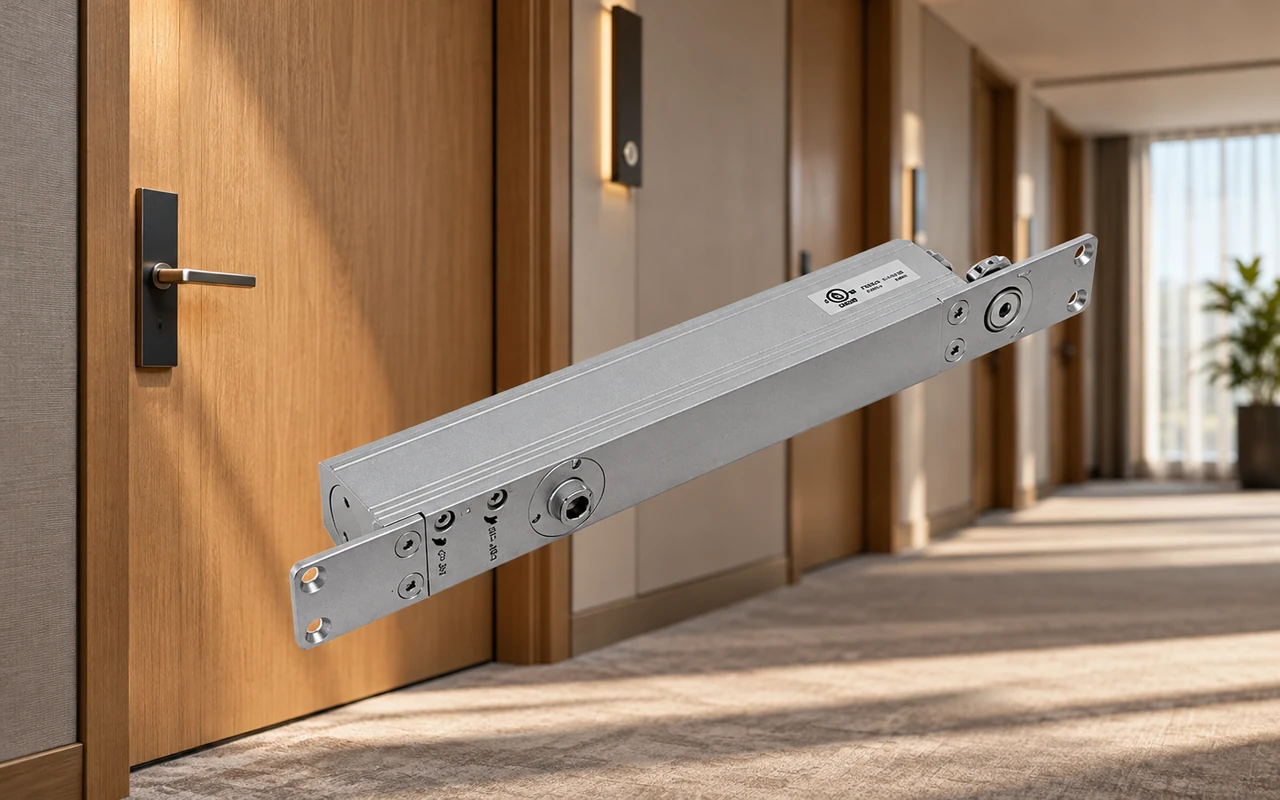
A concealed door closer — also called an overhead concealed door closer, or a hidden door closer — sits inside a pocket routed into the door leaf or the frame header. Once the door is shut, no hardware is visible. That is why hotels, retail and glass-fronted offices specify it.
The trade-off is timing. A surface-mounted closer is drilled and screwed on site, so a late change costs a few minutes. A hidden unit needs the pocket cut to a template before the door is finished, so the model, arm type and functions have to be settled early. Understanding how the mechanism works makes ordering much easier — see what overhead concealed door closers are.
What Are the 8 Checks Before You Place an OEM Order?
1. Will your door and frame accept the pocket?
A concealed closer needs enough material in the door top rail or the frame header, plus a routing template from the manufacturer. Send your door drawing and ask for the template before confirming the model. If the rail is thin, or the door is already finished, a hidden unit may not be practical. The concealed door closer installation guide walks through the pocket, alignment and tooling.
2. Do the published weight and width figures cover your doors?
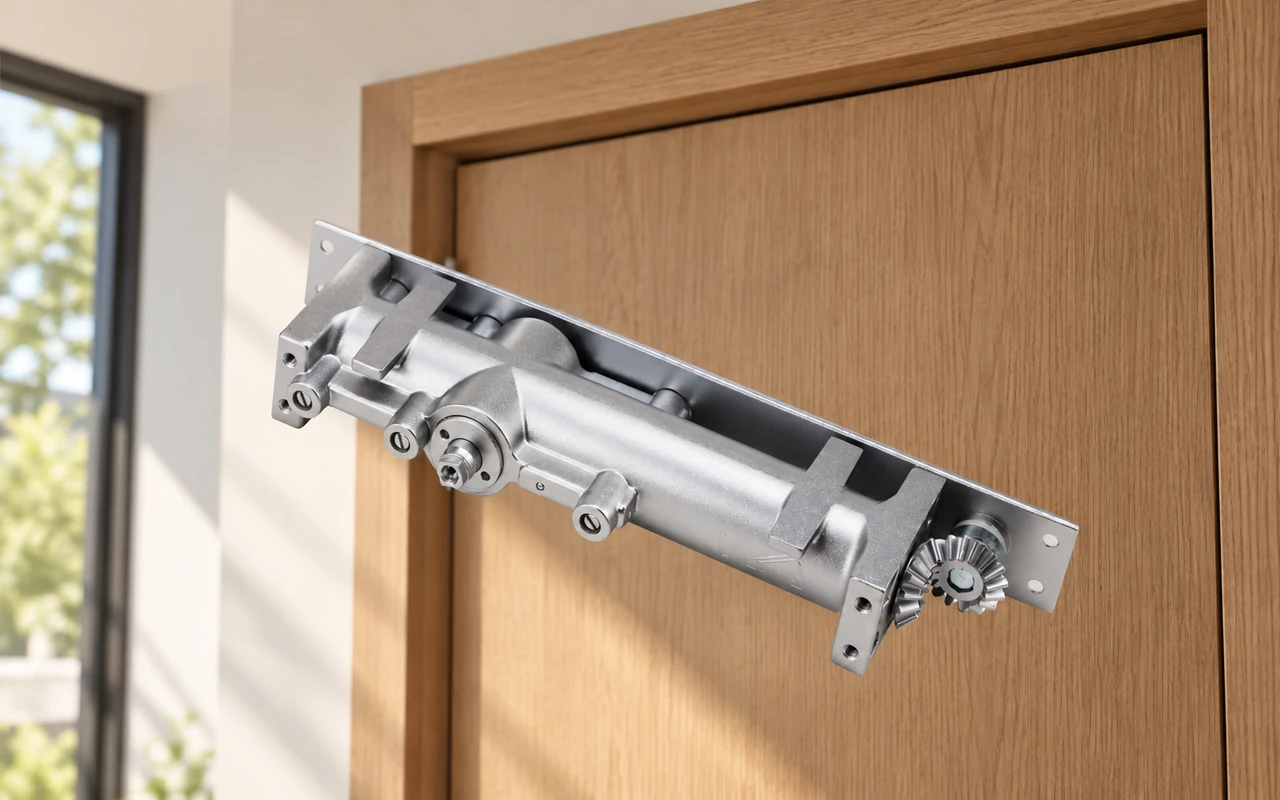
Hidden models are sized by maximum leaf weight and width, not by how the door looks. The T96 covers leaves from 25 kg to 85 kg and up to 1,100 mm wide. The 1035 adjustable concealed door closer takes up to 100 kg and 1,250 mm, with a 37 mm body that fits standard door profiles. Compare those maximums against your door schedule — not against your average door.
3. Is the power size fixed or adjustable?
Power size is the spring strength that pulls the leaf shut. European models grade it EN 1 to EN 6, and North America uses ANSI/BHMA sizes. A fixed size means one SKU per door weight. An adjustable model such as the 1035 covers EN 3, 4 and 5 through a valve, so one model serves more of your range. Fewer SKUs mean less stock, simpler ordering and fewer wrong shipments.
4. Which closing functions are standard, and which are optional?
Two adjustments matter most: closing speed (the main sweep) and latching speed (the last few degrees that pull the bolt into the strike). Backcheck cushions the door when someone throws it open. Delayed action holds it briefly for trolleys and wheelchairs. Hold-open keeps it open on purpose.
Optional items are the usual source of order errors. On the 1035 the sliding arm with hold-open is optional, not standard. Confirm each function on the exact sub-model, in writing. The hold-open vs non-hold-open comparison explains where each belongs.
5. How heavy will the door feel to open?
Hidden hardware can make a door feel heavier, because the mechanism is smaller and the arm geometry changes. Cam-action models reduce opening resistance while keeping latching force. The T96 concealed cam door closer is built this way for entrances pushed all day by staff, children and older users. If accessibility is part of your tender, test the opening force on a sample door rather than on paper.
6. Do the certificates cover your exact model and market?
A certificate is only useful when it names the model, configuration and standard your buyer needs. One listing does not automatically cover a whole range, and a European document does not prove approval in the Middle East or North America. Ask for the current certificate for the exact SKU, plus the door assembly it was tested in. OUBAO publishes UL-certified concealed models; confirm the scope before you print a datasheet.
7. Can the finish, branding and packaging match your line?
Private-label orders sell on presentation, so settle these before pricing. On the concealed models we supply, standard finishes include silver, bronze and gold, while custom surface treatments, spring settings, logo and packaging can be discussed through the OEM/ODM process. Ask which changes affect the schedule and which stay standard, and confirm the installation instructions, drilling templates and spare parts your installers will need.
8. Are the commercial terms in writing?
Get a quotation that lists the exact model and sub-model, power size, functions, finish, branding, packaging, quantity, sample terms, delivery schedule, warranty coverage and acceptance criteria. Verbal answers about schedules or guarantees are worth little when a container is late. Also agree what you check on arrival, and what happens if a batch does not match the approved sample.
How Do the Three Hidden Formats Compare?
| 100 Series | 1035 Series | T96 | |
|---|---|---|---|
| Listing | UL certified | EN 3–5 power | UL certified |
| Power size | Confirm per sub-model | EN 3–5, valve adjustable | 2–4 |
| Max door weight | Confirm per sub-model | 100 kg | 85 kg |
| Max door width | Confirm per sub-model | 1,250 mm | 1,100 mm |
| Body thickness | Confirm per sub-model | 37 mm | Confirm per sub-model |
| Signature point | Slim overhead, invisible | Backcheck, optional hold-open arm, non-handed | Cam action, light opening |
Sub-models, hole patterns and approved configurations differ within each series. Work from the datasheet and template for the exact SKU you intend to stock, not from the series name.
FAQ
Is a hidden door closer the same as an overhead concealed door closer?
Yes. Hidden door closer, invisible door closer and overhead concealed door closer describe the same product family: the mechanism is recessed in the door leaf or the frame header instead of surface-mounted on the door.
Can one unit fit both left- and right-hand doors?
Some models can. The 1035 is non-handed, so a single unit fits either handing and you carry one SKU instead of two. Confirm handing for every other model before you plan stock.
Can a concealed door closer go on a fire door?
Only where the closer, the door leaf and the frame together are covered by the relevant test evidence for that configuration. A component certificate alone does not approve every door assembly, so check the scope against the door you are supplying.
What Should You Send With Your OEM Enquiry?
To recap: check the pocket and template, leaf weight and width, power size, closing functions, opening feel, finish and branding, model-level certificates, and written commercial terms. Buyers who work through those eight points usually need fewer samples, shorter approvals and less rework on site.
Send OUBAO your door type and schedule, the target market, the documents your buyer requires, the models you are considering and your estimated quantity. Our team will confirm the suitable configuration, the template and the quotation.