Quick Answer
A sample answers the questions a catalogue cannot. Before a bulk order, put your industrial door closer sample through seven tests: door fit, opening force, closing and latching speed, hydraulic functions, body and mechanism build, finish durability, and the paperwork behind the model code. Each test removes one risk from the order. OUBAO manufactures door closers on a 106,000 m² base and endurance-tests them to 2 million cycles in a CNAS-accredited laboratory, so buyers can verify the exact unit before scaling up.
A bulk order is a commitment you live with for years. This guide runs through seven tests you can run on an industrial door closer sample in a day, what each proves about cost, quality and delivery, and what to send with a sample request. It is for distributors, importers and procurement managers. Still comparing series? Start with the OUBAO door closer range.
Why Does a Sample Decide a Bulk Order?
Why does a sample beat a datasheet?
A datasheet gives you numbers; a sample gives you evidence. You can hold the housing, feel the arm move and check the casting finish. Documents still matter — how door closers are graded explains the thresholds behind a Grade 1 claim — but a sample shows whether a factory can repeat that quality at volume.
When should you test a sample instead of trusting the catalogue?
Order a sample when:
- You are adding a new industrial door closer line for resale.
- The door is heavier or wider than your usual stock.
- The opening is high-traffic, fire rated, or on a coastal or humid site.
- Your customer wants your own logo, finish or packaging.
What Are the 7 Tests to Run on an Industrial Door Closer Sample?
Test 1: Does the sample fit your door schedule?
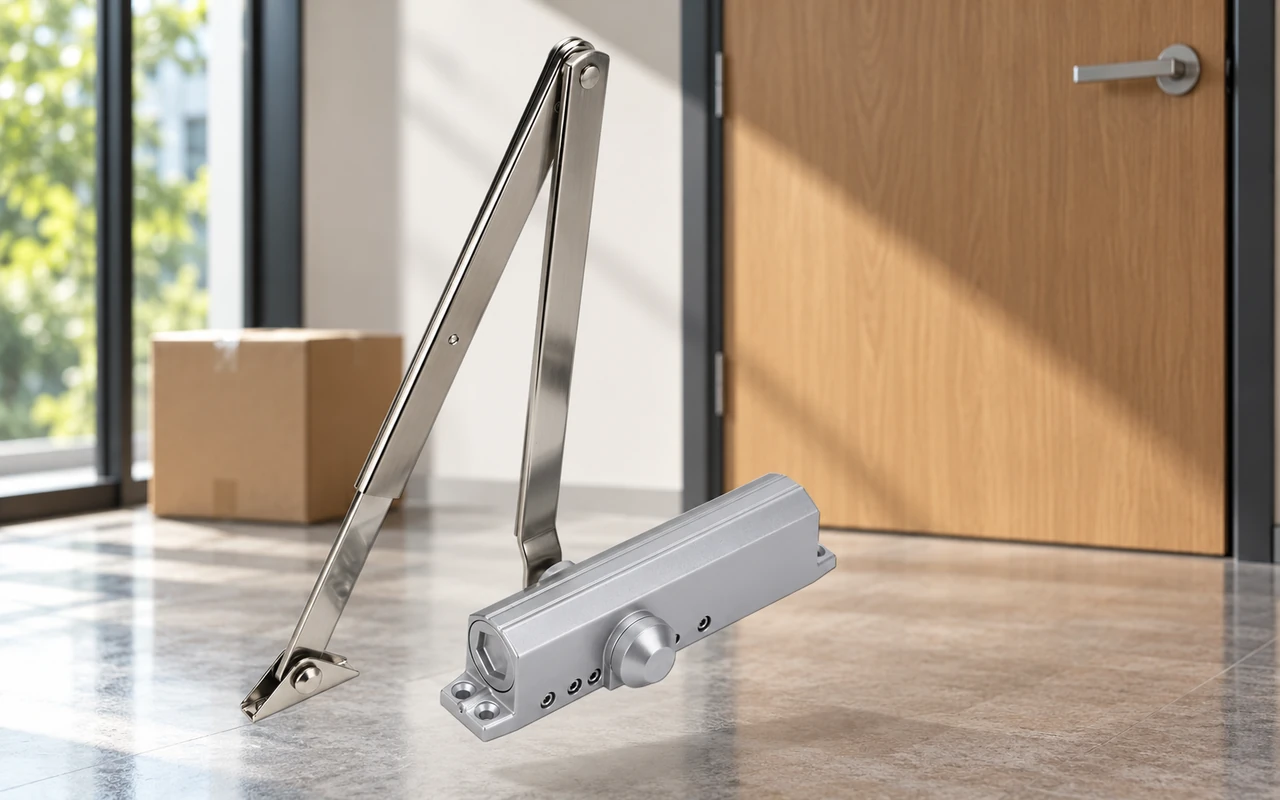
A door schedule lists every door with its width, weight, material and frame type. Check the industrial door closer sample against it first. The power size is a maximum rating, not a target, and it must cover both leaf width and leaf weight. Then check body length and mounting hole spacing against the frame, and the mounting style — standard, parallel arm, top jamb or slide arm — because the same body can behave differently once the arm changes. The door closer categories show how those styles differ.
Test 2: Does the door open with acceptable effort?
Accessibility rules on public buildings limit how hard a door may be pushed. Mount the sample, push the leaf and note the effort. If it feels heavy, the closer is probably set one size above what the door needs; most adjustable units let you step the spring force down on site.
Test 3: Do the closing and latching speeds adjust cleanly?
Two valves normally control the door: one for the sweep, one for the final latch. Turn each through its full range. The door should close smoothly and pull firmly into the frame. Test at both ends of the power setting, because a unit that latches well at size 6 may not at size 2. Our adjustment steps show the order to set each valve.
Test 4: Do the hydraulic functions match the model code?
BC usually means back check, DA means delay action, and a hold-open arm is separate. Confirm the sample does what its code promises — that delay holds the door briefly for a trolley, and that back check cushions a hard push before the door strikes the wall. Optional functions are not standard on every sub-model, so a series name alone is not enough; see what delay action changes at the door.
Test 5: Is it genuinely a heavy duty door closer?
Power size tells you what the closer can control; duty tells you how long it survives. A heavy duty door closer is defined by cycle life and housing strength: a cast iron door closer body rather than a light alloy shell, a hardened rack-and-pinion gear, needle bearings, and tolerances tight enough to keep the oil inside. Clamp the sample, cycle it a few hundred times, then check for oil weeping around the spindle. As one reference point, the OB03 heavy duty cast iron door closer is published as adjustable from size 1 to 6 for doors up to about 150 kg. Current datasheets list OB03BC with UL, UL10.C and ANSI A156.4 Grade 1, while OB03T is listed without those marks, so match the certificate to the sub-model rather than the series.
Test 6: Will the finish survive your market?
Finish is a returns problem waiting to happen. Check that the plating or coating covers the whole body, including edges and screw holes, because that is where corrosion starts. For coastal or humid sites, ask for the salt-spray result recorded for that finish and the hours it was run to. If your market has a colour preference, confirm the sample matches the chip your customer approved.
Test 7: Does the paperwork match the exact model?
This is the test buyers skip, and the one that stops shipments. Match three things: the model code printed on the sample, the scope of the certificate or fire listing, and the model code on your purchase order. Grade 1 and Grade 2 closers look alike, so our Grade 1 vs Grade 2 comparison breaks down the difference. On a fire door, confirm the listing covers that closer in that mounting configuration, and that instructions and packaging will come in the language your retailers need.
How Do You Run These Tests Without a Lab?
You do not need one. Mount one sample on a real door of the type you sell, and keep a second unit sealed as your reference. Log push effort, closing time, latching and leak check on a single page, then photograph the nameplate and packaging. That file becomes the standard you measure the bulk shipment against, because your test proves the closer works on your door.
What Should You Send With Your Sample Request?
Send your door schedule and we will match the industrial door closer sample to it:
- Leaf width, height, thickness, weight and material.
- Frame type, reveal, hinge side and handing.
- Mounting style and any prepared pocket.
- Traffic level and environment: humidity, coastal air, temperature.
- Required functions: back check, delay action, hold-open, adjustable power.
- Target market, approval documents, finish, quantity, and branding or packaging.
With those details, OUBAO can confirm the configuration, parts list and sample plan in the first reply.
FAQ
How many samples should you test before a bulk order?
Test at least two: one to mount and cycle on a real door, one to keep sealed as a reference. On a project with several door weights, sample each power size you plan to stock, because a size 2 and a size 5 can behave differently within one series.
Is a free sample the same as a production unit?
It should be, but ask where the sample came from. A unit pulled from production tooling represents the bulk order; a hand-built prototype may not. Ask for sample and shipping terms in writing, since policies differ by order type.
What most often fails on a bulk order after a good sample?
Model drift: the industrial door closer that arrives is not the one you approved. A different sub-model is shipped, an option such as delay action is missing, or the finish is a shade off the approved chip. Attach the approved sample specification and photos to the purchase order.
How much time does sampling add to the project?
Sampling adds weeks, not months, if you agree the sample lead time and approval steps up front. Run sample testing in parallel with your commercial discussions, so the order can be released once the sample is approved.
Sample First, Order Second
A bulk industrial door closer order is only as good as the sample behind it. Fit, opening force, speed control, hydraulic functions, build quality, finish and paperwork — seven tests, one afternoon, and far fewer surprises at the port. Keep a sealed reference unit, attach its specification to the purchase order, and treat every change as a new approval. If the opening is fire rated, our fire-rated door closer guide covers the extra documents. Send your door schedule and target market, and OUBAO will confirm the model, the sample plan and the lead time.